


 Back
Back
Where to find an audience that has stopped watching traditional television?
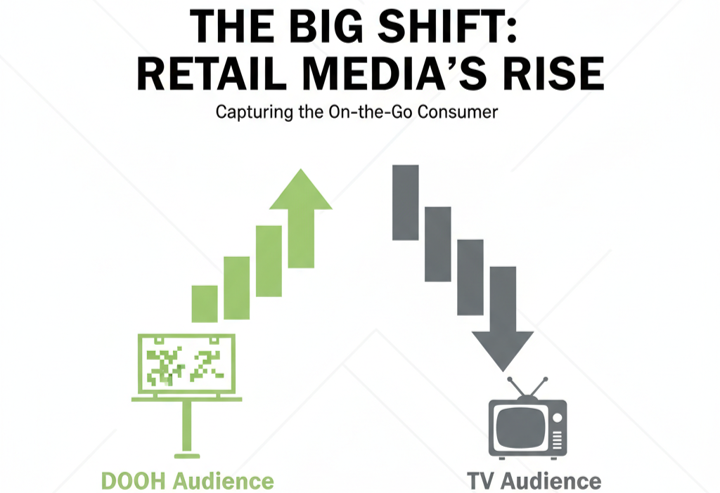
Where to find an audience that has stopped watching traditional television?
A professional perspective on the new logic of reach
The past few years have been a period of deep transformation for the media market. It is no longer a question of whether linear television is losing significance — the question is how brands should respond to the changing structure of video consumption.
According to Nielsen data, streaming now accounts for almost half of total TV screen time in the U.S. and, for the first time, has surpassed the combined consumption of broadcast and cable (The Gauge, 2025). This is a symbolic moment: video is not disappearing — the way it is distributed is changing.
Meanwhile, Ofcom, in its Media Nations reports, notes that in the U.K., younger age groups (16–24) spend many times more time on online platforms than on linear TV, with YouTube becoming one of the main sources of video consumption on TV screens.
Omdia reports, on the other hand, show a global decline in pay-TV subscriptions and a systematic growth in streaming models (SVOD, AVOD, FAST).
This is not a temporary fluctuation. It is a structural change in behavior.
Who is considered “hard-to-reach” today?
In marketing practice, the “hard-to-reach audience” is not limited to the youngest viewers. It includes:
- Mobile urban residents aged 25–45,
- Active drivers,
- Entrepreneurs and higher-income individuals,
- Premium consumers,
- Users of ad-free paid subscriptions.
Pew Research Center studies indicate that younger and wealthier groups are clearly moving away from traditional TV in favor of digital platforms. At the same time, World Advertising Research Center (WARC) reports highlight the growing problem of reach fragmentation and the difficulty of building effective frequency solely through TV.
For brands, this means one thing: the gap between planned and actual reach is widening.
Recommendation #1: Build a “video stack,” not a TV plan
In today’s reality, an effective media plan relies on a layered approach:
- Linear TV for broad initial reach,
- CTV and online video for the digital audience,
- Offline channels to reinforce attention and frequency.
Reports from Dentsu and GroupM emphasize that the future of successful campaigns lies in media integration, not the dominance of a single channel.
The key question is: where is this audience physically present when they are not consuming linear TV?
Recommendation #2: Look for the audience in points of daily mobility
If viewers are not watching TV, they are not disappearing from the market. They are:
- Commuting to work,
- Filling up their cars,
- Shopping,
- Making payments.
Studies from the Out of Home Advertising Association of America show that OOH remains one of the media with the highest noticeability and growing effectiveness when integrated with mobile.
IAB Europe reports further indicate that DOOH is one of the fastest-growing segments of the advertising market in Europe, thanks to its ability to combine offline presence with digital data.
Retail Media in fuel station environments fits this trend: regular foot traffic, transactional context, and repeat visits.
Recommendation #3: Work with attention, not just impressions
Modern marketing discussions increasingly focus on attention quality. Lumen Research shows that real-time contact with advertising directly affects recall and campaign effectiveness.
In the point-of-sale environment, where the consumer waits for the transaction to complete, contact is neither accidental nor “scrollable.” It occurs in a real decision-making moment.
This is a fundamental difference from the content-interruption model in linear TV or digital.
Recommendation #4: Use offline as the starting point for omnichannel
Modern DOOH allows integration with mobile retargeting, geolocation analytics, and performance campaigns.
According to McKinsey & Company, effective future marketing strategies rely on combining behavioral data with offline and online touchpoints, creating a cohesive consumer experience.
Offline is no longer the end of the funnel.
It becomes the beginning of the journey.
Strategic conclusion
Television is not disappearing from the media mix.
But it is no longer its center.
Independent sources — Nielsen, Ofcom, Omdia, Pew Research, WARC, IAB Europe — confirm clearly: audiences are dispersed, younger and more mobile segments are moving away from linear TV, and integrated media is becoming increasingly important.
Reaching the hard-to-reach requires:
- Thinking in terms of behavior,
- Being present at points of daily mobility,
- Working with attention,
- Integrating offline with digital data.
Retail Media at fuel stations fits this direction — a regular, transactional, and high-quality environment.
Today, the question is no longer: “Does the audience watch TV?”
Instead:
At what real moment of their day can we reach them with maximum attention and purchase context?